Part Three: Going Undercover


SafeRec Team
13 October 2026
We posed as recruitment agencies and went undercover. One broker promised an 80% saving on employer’s National Insurance, accompanied by assurances that everything would look perfectly “vanilla”.
About our Investigation Series: This article is Part Two of our five-part investigation uncovering questionable payroll arrangements, how they are sold and, crucially, how businesses can protect themselves.
Explore the Full Investigation:
- Part One: The Investigation Begins
- Part Two: The Arrangement Behind the Payslip
- Part Three: Going Undercover
- Part Four: When Controls Are Challenged (Coming Soon)
- Part Five: Title to Be Confirmed (Coming Soon)
A quick note on the length of this article
We know this is a long read, and we've tried to keep it as short as possible. But we felt it was important to keep the details we believe are essential to understanding the conversations, how these arrangements are sold and what happens behind the scenes. We hope this provides valuable insight and helps bring greater awareness to the risks facing our industry.
The story below is one of several enquiries conducted using fictional recruitment agencies and more than five brokers who sell payment solutions to businesses via recruitment agencies and umbrella companies. We chose to examine this case in detail because the proposed saving relied on a payment mechanism HMRC had specifically warned businesses against using.
The broker called it a Bill of Exchange. HMRC has described the use of such instruments to supposedly settle tax liabilities as a fraudulent payment model marketed to employers, recruitment agencies and temporary labour businesses. The purpose of publishing the conversations is to bring that warning into the room. A written alert tells a business what to avoid. A recording allows it to hear how the very thing it should avoid can be presented as a sensible commercial opportunity.
When the broker began explaining the proposition, one of her first reassurances concerned how ordinary it would look:
It looks extremely clean. It’s very vanilla at the front. It’s the back bit that makes it clever. But if anybody was auditing, it doesn’t look anything different than a normal umbrella.
The person listening was not preparing to place a workforce. They were taking part in a controlled SafeRec investigation.
The agency on the other end of the phone
Our operation began during Q1/Q2. Several fictional recruitment identities were created, and more than five brokers were engaged across different proposed providers and arrangements. We wanted to understand how these propositions were marketed, what would happen when a prospective customer expressed interest and how that intelligence could inform the continuing development of our controls.
For this enquiry, the commercial scenario involved healthcare and social-work recruitment. Our investigator presented themselves as a recruitment lead trying to get a project underway, with management approval to obtain and a finance function that would need to understand the invoices.
A credible enquiry required more than a company name. It needed practical questions: how workers would be registered, what information payroll would require, when invoices would arrive and what the agency would be expected to pay. Those questions allowed the relationship to develop beyond an introductory sales pitch.
The approach was patient. We allowed people to explain their propositions, asked follow-up questions and returned to points that remained unclear. The investigators expressed commercial interest and sometimes put their own understanding to the people they were speaking with. Their questions remain part of the record, alongside the answers.
There were also friendly messages, missed calls, documents to review and reminders about a proposed first payroll. Those exchanges gave the enquiry the texture of an ordinary supplier relationship. The exceptional financial promise was developing inside a familiar commercial process.
No real workers were onboarded through this controlled test. No agreement was completed, payroll processed or funds transferred. The customer was fictional so that we could examine the proposition without exposing a workforce to it.
An industry worth protecting
The businesses doing the work properly have every reason to want these propositions examined. Recruitment agencies, umbrella companies and advisers should compete on service, expertise and reliability, not on apparent savings created by a tax liability that remains unpaid.
These offerings do not belong exclusively to umbrella companies. HMRC’s warning expressly addresses recruitment agencies and other employers. An agency operating its own payroll has liabilities to settle too; describing workers as “direct PAYE” does not answer whether those liabilities have been paid. The same purported payment mechanism can be marketed to different types of business.
This investigation concerns that market for non-compliance, not a judgment that the wider industry operates this way. It is also why we have chosen to examine one case closely rather than combine unrelated conversations into a single account.
Meet the people behind the conversations
Before we listen to the recordings, two introductions will help explain how this enquiry developed.
Every conversation featured in this article is drawn from genuine recordings made during our investigation. The speakers' voices have been altered for anonymity, and names have been changed. The accompanying illustrations are fictional representations. Any extracts used in this article have been selected to preserve the meaning and context of the original exchanges.
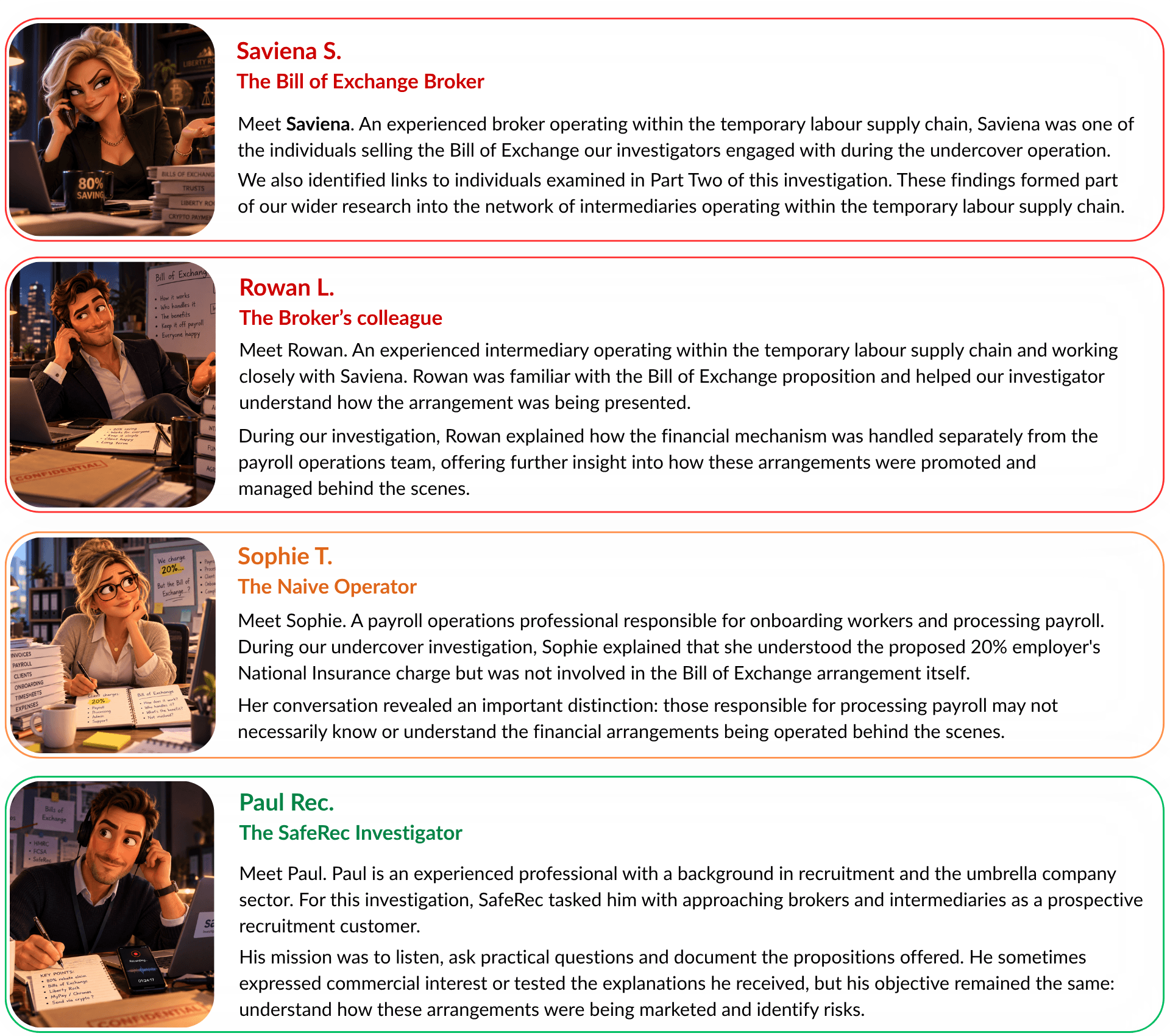
With those introductions made, we can return to the first call and the proposition that set this enquiry in motion.
An extraordinary saving, explained as ordinary payroll
The broker, Saviena, began with the features a recruitment business would recognise. Workers would receive PAYE payslips. The proposed provider that holds an accreditation other than SafeRec would handle the usual employment-related administration. The initial processing charge would be £2 per payslip, and documents would be supplied so the customer could complete its due diligence.
Then she introduced the mechanism:
So essentially, the way it’s set up, it’s called the Bill of Exchange.
The explanation moved into a ten-stage process involving the monetary system. Yet the part intended to attract the customer was easy to understand: an 80% saving on employer’s National Insurance. Saviena described a choice. The customer could be invoiced for only 20% of employer’s National Insurance, or pay the full amount and have the claimed savings returned later. She added:
Depends how you want to do it and it depends how you want your books to look.
Shortly afterwards came a more revealing qualification:
But the saving, which I’m not going to put in writing, which I’m making clear over the phone and will tell you face to face, is 80% of the employer’s national insurance.
The central promise was precise enough to sell but, according to the broker herself, not something she would document.
For a customer, that should change the conversation. Before deciding how an invoice should look, it needs a credible explanation of how the underlying liability will be settled. Before relying on a saving, it needs to understand why the person offering it is unwilling to record the promise on which the decision depends.
Instead, the prospective customer was being invited to accept the financial result while leaving the explanation to somebody else.
The following is an extract from a conversation recorded as part of our investigation. The voices have been digitally altered for publication purposes. The original words, tone and substance of the conversation have been preserved.
The complicated part was always somewhere else
Saviena’s explanation referred to state trusts, notarised affidavits, financial institutions and a business called Liberty Rock, which she described as being involved in the mechanism and its supposed legal protection. The language was technical, the process sounded elaborate, and the reassurance was always the same: the customer would not need to understand the complicated part. Someone else would take care of it.
At one point, Saviena went even further, claiming that the arrangement could not be successfully challenged without undermining the entire monetary system.
…they can’t actually take it to court without bringing down the whole of the UK’s monetary system and how it’s set up, which is a big plus.
The implication was extraordinary: the arrangement was supposedly beyond legal challenge because questioning it would threaten the UK's monetary system. Yet a legitimate tax arrangement should be capable of demonstrating how it complies with the law, without relying on such claims.
HMRC has already addressed these schemes directly. Its tax fraud warning on Bills of Exchange explains that such instruments are not accepted as payment of tax liabilities. The warning also refers to a winding-up case in which the court accepted that the instruments presented did not constitute valid payment.
The supposed legal protection was therefore being presented as a strength of the arrangement, despite HMRC having publicly rejected its underlying premise.
Dan Neidle, founder of Tax Policy Associates, has also investigated Liberty Rock's purported mechanism, including its reliance on supposed trust arrangements, Bills of Exchange and notarised documents. His analysis exposes the fundamental flaw: presenting paperwork and claiming that a debt has been settled does not mean the debt has actually been paid.
Why would a recruitment business even consider an arrangement like this?
Recruitment businesses are operating in a challenging market, with tighter margins, rising employment costs and increasing compliance obligations. Against that backdrop, a promise to reduce employer's National Insurance costs by 80% could be commercially attractive.
When such a proposition is supported by familiar PAYE payslips, employment contracts, compliance documents and an operational payroll team, it may appear more credible than the underlying mechanism warrants. Particularly when the complicated legal explanation is supposedly being handled by specialists.
But understanding the temptation does not make accepting it acceptable.
The market is difficult for everyone. Compliant recruitment agencies and umbrella companies are facing the same economic pressures, the same increases in employment costs and the same regulatory requirements. Those pressures cannot become an excuse to cut corners, avoid tax obligations or gain an unfair advantage over competitors who are doing the right thing.
SafeRec strongly warns recruitment agencies, umbrella companies, MSPs and end clients against arrangements claiming that tax liabilities can be reduced or discharged through Bills of Exchange or similar mechanisms that HMRC does not recognise as valid payment.
A convincing salesperson, an impressive compliance pack or a promise of legal protection cannot make an invalid tax-payment arrangement legitimate. And the potential consequences can extend far beyond the business promoting it.
The overwhelming majority of businesses in our industry are working hard to meet their obligations in difficult conditions. They deserve a level playing field. When a minority seeks an advantage by avoiding liabilities that others fulfil, it damages legitimate competition and undermines confidence in the entire supply chain. The harder the market becomes, the more important it is that everyone competes by the same rules.
But as the conversation continued, our investigator discovered that the proposed financial benefit came with another feature, one that raised questions extending well beyond the commercial pressures facing recruitment businesses.
The money did not have to return to the business
The next revelation concerned where the supposed saving could go.
Saviena explained that the money did not necessarily have to return to the recruitment agency. It could, she claimed, be directed to another company or even to individuals:
You don't have to go back through the company. You can go to a different company, you can go to individuals. We're not asking any questions.
And the conversation went further.
…if you want this 80% to be returned back to an individual's account a couple of individual's account that's fine if you want it in cryptocurrency apparently they can do that or bitcoin I don't understand those.
This was no longer simply a conversation about reducing employment costs. The broker was describing an arrangement in which substantial sums of money could potentially be directed outside the business, including to individuals.
And that raises an important question about transparency across the entire recruitment supply chain.
Recruitment is an industry built on relationships and trust. Every day, recruitment consultants, managers and directors make commercial decisions in the interests of their businesses, clients and workers. The overwhelming majority take those responsibilities seriously, often while navigating increasingly complex regulations and commercial pressures.
Labour supply chains can involve several organisations, each with its own responsibilities and commercial arrangements. An MSP may work with multiple recruitment agencies, an agency may engage a second-tier supplier, and another business may operate its own PAYE payroll or work with an umbrella company.
These purported Bill of Exchange arrangements can be marketed by different employers and businesses responsible for PAYE liabilities, not just umbrella companies. Their consequences may also extend to other organisations within the labour supply chain, even where those organisations are not directly involved in the attempted tax-payment mechanism.
This is why good governance and visibility matter so much.
Not because recruitment businesses should question the integrity of their teams or commercial partners, but because even the most responsible professionals need reliable information and clear processes to make informed decisions.
Understanding who is providing the service, what has been agreed, how commercial incentives operate and whether tax liabilities are actually being settled should be part of that process.
The broker's willingness to discuss payments to individuals, including through cryptocurrency, introduces an additional concern: the possibility of financial incentives that are not visible to every organisation involved.
For recruitment agencies, MSPs and end clients, the lesson is not to distrust the people making decisions. It is to give them the visibility, safeguards and support needed to understand the arrangements being offered and protect the wider supply chain.
The possibility of payments being directed to individuals makes that transparency all the more important.
The following is an extract from a conversation recorded as part of our investigation. The voices have been digitally altered for publication purposes. The original words, tone and substance of the conversation have been preserved.
The paperwork told a different story
Following the introductory discussions, Saviena supplied a compliance pack, sample payroll material, a payroll timeline, an agency agreement and a worker contract. Templates for new starters and hours followed.

Her accompanying message was reassuringly familiar:
Lovely to speak with you - here is the most pertinent information that I think you will need - let me know if you need anything else.
Everything appeared to be standard documentation that a recruitment agency would expect from a payroll provider.
But one clause in the agency agreement stood out:
No refunds or rebates are applicable.
Yet the broker had been promoting a supposed rebate equivalent to 80% of employer's National Insurance, while expressly refusing to put that promise in writing.
The paperwork described an ordinary payroll arrangement. The conversations told a very different story. And this illustrates a fundamental weakness in traditional due diligence.
Non-compliant operators have existed in the recruitment industry for decades. They know what documentation is expected, what it should contain and how to present an arrangement that appears credible. This is why relying on a one-off review of documents, as has historically been central to accreditations or compliance frameworks, is no longer enough.
Contracts, policies and compliance packs matter, but they cannot establish whether the taxes deducted from payroll are actually being paid to HMRC.
That requires continuous, independent verification: auditing payroll, reconciling it with HMRC reporting and checking that the resulting liabilities are being properly settled, taking account of legitimate payments, credits and adjustments. A business can have all the right paperwork and still fail to meet its obligations.
And as our investigation demonstrated, the most important part of an arrangement may be precisely what has been left out of the documents. Compliance cannot be established solely by reviewing what a provider chooses to show you. It must be verified through what that provider actually does.
The handover brought a different explanation
Our investigator was subsequently introduced to Sophie (name altered), the proposed payroll company's operational contact. The conversation covered standard onboarding and payroll processes. However, when questioned about the Bill of Exchange arrangement, Sophie explained that it was outside her responsibilities.
It's not something that I deal with or have ever dealt with in terms of payroll. At this point, I can't answer those questions. I'm purely operations.
She suggested returning to Saviena for clarification before proceeding.
There was no evidence from this conversation that Sophie understood or was involved in the proposed Bill of Exchange mechanism. She appeared to be describing the payroll operations she was responsible for, while the supposed tax-saving arrangement was being discussed elsewhere.
Later in the call, Sophie described payroll closure, RTI submissions and invoicing, including:
…and you'll be invoiced for your 20% ERNI as well.
The percentage had now appeared in an operational discussion, although this did not establish how the remaining liability would supposedly be settled. And this raises an important issue that extends far beyond this particular investigation.
Non-compliance does not necessarily mean that everyone working within an organisation knows something is wrong.
A business can have experienced payroll professionals, responsible managers and trusted client relationships, while decisions affecting its tax obligations are made elsewhere.
This becomes particularly relevant when a recruitment agency or umbrella company changes ownership. The operational and commercial teams may remain unchanged, preserving the relationships they have built with clients, while responsibility for financial decisions and tax settlement passes to new owners.
There is nothing inherently suspicious about an acquisition. But it should trigger renewed scrutiny of the organisation, its ownership and its financial practices, rather than an assumption that yesterday's assurances remain sufficient today.
Legal structures, ownership, operational processes, payroll calculations, HMRC reporting and actual tax payments all matter. No single document, conversation or audit can provide the complete picture.
The people processing payroll may be doing their jobs correctly. The payslips may look entirely normal. But if the resulting tax liabilities are not being settled, the wider arrangement can still expose the supply chain to serious risk. Effective compliance comes from connecting those checks, not treating any one of them as sufficient on its own.
The following is an extract from a conversation recorded as part of our investigation. The voices have been digitally altered for publication purposes. The original words, tone and substance of the conversation have been preserved.
“That’s really for somebody else to take care of"
When our investigator questioned the difference between the sales explanation and the operational discussion, Saviena’s colleague Rowan (this name has also been altered) offered an explanation for the separation.
…a payroll team is there to process and they will work out obviously everything that’s due but when it comes to the nitty gritty behind the scene that’s really for somebody else to take care of…
The words are important. The payroll team would work out what was due; someone else would deal with what happened afterwards.
Rowan also described himself and Saviena as freelance, working across different products and services. He named several companies in connection with the Bill of Exchange propositions they were discussing. Those were his statements about their work, not independent confirmation of either provider’s authorisation.
For the prospective customer, the questions were moving between people. The operational contact referred the mechanism back to the broker. The broker’s colleague explained that it sat away from the processing team. The absence of a joined-up explanation was being presented as a feature of the arrangement rather than a reason to question it.
A later WhatsApp message from Saviena returned to the familiar description:
It’s a standard, outsourced PAYE model under [this payroll company].

Calling the payroll standard obviously did not answer what made the promised saving possible.
The following is an extract from a conversation recorded as part of our investigation. The voices have been digitally altered for publication purposes. The original words, tone and substance of the conversation have been preserved.
The question a payslip cannot answer
This is where the opening reassurance about appearing “vanilla” under audit breaks down.
A payslip can show the correct tax calculations, and those figures can be accurately reported to HMRC, without proving that the tax has actually been paid.
That is the distinction this arrangement sought to exploit. The proposed Bill of Exchange mechanism was presented as a way to settle the liability without making a conventional payment, despite HMRC expressly rejecting such instruments as valid tax payments.
That distinction was already built into SafeRec’s framework. Certification combines legal and operational review with real-time payslip and RTI auditing, followed by monthly checks of the umbrella company’s HMRC tax account. The purpose is to examine calculation, reporting and settlement together.
The review needs to cover the relevant PAYE references and periods, reconcile liabilities with payments and legitimate adjustments, and investigate amounts that remain unexplained. A reported liability that has not been validly settled is a question the account review must resolve. It cannot be answered by saying that the payslip looks ordinary.
The same principle applies to an agency operating its own payroll. The employer’s name changes; the need to establish settlement does not.
This is why the intelligence from these conversations mattered. It showed how checks of one part of payroll could be invoked as reassurance for a different part that those checks did not establish. The answer is to follow the process through, rather than accept the seller’s choice of where scrutiny should stop.
The provider changed. The promise continued.
As the enquiry progressed towards the first payroll, Saviena informed our investigator that the original payroll company had changed its pricing.
She quickly offered an alternative:
Issue with [the company] as they have decided to change their pricing, but I have an alternative (and I think better) solution for you!

The timing deserves attention. According to the official court record, HMRC presented a winding-up petition against the original provider a few weeks after this text message.
We cannot establish whether Saviena knew about the petition or whether it influenced her decision to propose an alternative provider. The messages establish only that she attributed the change to pricing and continued offering the claimed tax saving through another company.
What was clear was that the provider could change, but the promise of extraordinary tax savings remained.
The following day, Saviena proposed another umbrella company, which she described as holding accreditation from a body other than SafeRec. She estimated that the arrangement could generate an “annual financial benefit of £480,000” for our fictional recruitment agency.

When our investigator asked which provider could offer the Bill of Exchange arrangement, Saviena recommended the company and confirmed the terms she claimed to have negotiated:
[The Company] will do £1.75 a payslip and 80% saving.
The 80% saving Saviena had initially refused to document was now being offered in writing, through a different provider.

And despite the change of provider, nobody had explained how that saving could lawfully exist.
The final answer came in writing
As the conversation approached its conclusion, Saviena drew a clear distinction between the available options. She claimed that one of the only accredited providers she could offer with the proposed 80% saving was the alternative company, which she presented as holding accreditation from another body.
She contrasted that proposal with what she described as conventional umbrella payroll through a SafeRec Certified provider:
straightforward umbrella with SafeRec and no savings whatsoever
She also suggested that a rebate might be available through charges to workers, although that would be fundamentally different from the supposed reduction in employer's National Insurance being promoted.
When our investigator asked one final time whether another provider could offer the Bill of Exchange arrangement, Saviena replied:
Don’t know of anyone SafeRec with the arrangement we need- sorry 😔. Speak Monday x

That distinction is reassuring, but it is not a reason for complacency. Compliance is not something an industry can achieve once and assume will remain effective indefinitely.
The risks facing businesses today are not necessarily the same as those they faced seven years ago, or even four years ago. Commercial models evolve, ownership changes, new intermediaries emerge and those seeking to exploit weaknesses in the UK system adapt their methods.
A due-diligence process that provided meaningful protection several years ago may no longer be sufficient today. And this is particularly important for recruitment agencies, MSPs and end clients that have established compliance frameworks and followed them consistently for years.
Doing everything your existing process requires does not necessarily mean that the process itself still addresses the risks you face.
The minority promoting non-compliant arrangements have had years to understand what businesses ask for, which documents they expect and what assurances they find convincing.
Our compliance frameworks must evolve at least as quickly as the risks they are designed to address. That means regularly challenging existing controls, looking beyond paperwork and ensuring that independent, ongoing verification remains central to supply-chain oversight.
Because the objective should never be simply to demonstrate that due diligence was carried out. It should be to establish, with reliable evidence, that the businesses throughout the supply chain are continuing to meet their obligations.
The responsibility to look beyond the obvious
The most revealing finding was not simply the promised 80% saving, but how convincingly it was presented through the familiar features of an ordinary payroll service.
Contracts, compliance documents and operational contacts all provided reassurance. Yet the fundamental question remained unanswered: how would the resulting tax liabilities actually be settled?
Compliance cannot be established by looking at individual elements in isolation. The commercial agreement, employment arrangements, payroll calculations, HMRC reporting and actual payment of tax must all tell the same story. This is precisely the principle on which the SafeRec Certification was built. Not simply to review what a business says it does, but to independently verify what happens in practice, through ongoing payroll auditing, RTI reconciliation and HMRC tax account checks.
But even that is not the end of the journey.
The methods used by those seeking to exploit the industry continue to evolve. Our responsibility is to evolve with them, investing in stronger controls, learning from what we uncover and challenging our own processes as rigorously as we challenge the businesses we review.
We do not believe any compliance framework should ever be considered a finished product. The moment you believe your controls are sufficient for every risk, you risk overlooking the next one. And this responsibility extends beyond SafeRec.
Recruitment agencies, MSPs, end clients, umbrella companies and advisers all have a part to play in creating an industry where compliance is evidenced, where legitimate businesses can compete fairly and where workers are protected.
That is ultimately why we are sharing this investigation. Not to suggest that every unfamiliar proposition is dishonest, or that every organisation should distrust its commercial partners. But to help the industry recognise when an impressive explanation is being used in place of verifiable evidence.
Our fictional recruitment agencies gave us access to conversations that would ordinarily remain behind closed doors. By publishing the recordings and messages, we hope to give the industry something equally valuable: the opportunity to recognise these propositions before becoming involved in them.
But uncovering the arrangements was only the beginning.
The next challenge was to take what we had learned, confront the gaps in the evidence and ask the businesses involved to demonstrate that their practices could withstand independent scrutiny.
And what happens when those questions are no longer hypothetical?
Next: Part Four — When Controls Are Challenged.