The £59.2 billion UK tax gap: What HMRC's uncertainty ratings reveal

SafeRec Team
27 October 2026
Our latest article explores what the tax gap represents, how HMRC assesses uncertainty, and why this matters for the temporary labour market.
With the Budget approaching, we're expecting to hear plenty about the UK's £59.2 billion tax gap. It's a pretty large figure, and one that plays an important role in shaping government decisions about tax compliance. But if you look more closely at how HMRC calculates the tax gap, you may notice something particularly interesting.
HMRC is an organisation based on transparency and therefore goes to the step to share their methodology. While most readers of the tax gap might not go to this extent, at SafeRec we did. What you will see in this article is the low confidence within the estimation that commentators online and on TV forget to mention when they discuss the tax gap.
For SafeRec it was important to talk about particularly when you consider how much influence tax gap estimates can have on government policy.
For recruitment agencies, MSPs and umbrella companies, this is particularly relevant. Our industry has already experienced significant regulatory change, with new responsibilities and compliance requirements that have an effect on how businesses operate. If decisions are being informed by estimates that carry considerable uncertainty, it's reasonable to ask how much confidence we can place in the evidence behind them.
So, what do HMRC's uncertainty ratings actually tell us, and what can we learn from them about making tax enforcement more effective?
What does the £59.2 billion tax gap actually represent?
The tax gap is the difference between the amount of tax HMRC estimates should be paid and the amount it actually collects. According to HMRC's published statistics, the estimated tax gap for 2024/25 was £59.2 billion, representing 6.4% of the tax theoretically due. That also means HMRC estimates that 93.6% of all tax due was collected.
Importantly, the £59.2 billion isn't an exact amount of unpaid tax that HMRC has identified. It's an estimate, calculated using information from compliance checks, economic models, HMRC records and statistical methods.
Some forms of non-compliance can be identified through investigations and existing records. Others, particularly where activity is deliberately hidden, are much harder to measure.
To help explain the reliability of its calculations, HMRC publishes uncertainty ratings for different components of the tax gap. And these reveal some interesting differences in how confidently the figures can be interpreted.
How confident is HMRC in its own estimates?
HMRC assesses uncertainty by looking at three areas: what its calculations cover, how the estimates are produced and the quality of the information available.
The HMRC Tax Uncertainty Rating is split in three sub category for each tax category:
- Scope uncertainty: “coverage of the appropriate tax base and taxpayer population”; “whether the model accounts for all potential forms of non-compliance”; and “any overlap between any 2 components of the tax regime”.
- Methodology uncertainty: “complexity and challenges of the model, including the quality and impact of its assumptions”; “potential sources of bias, such as methodological bias, sampling errors, or reliability concerns”; and “model uncertainty factors, including volatility, margin of error, confidence intervals, and unaccounted external risks”.
- Data uncertainty: “data suitability for purpose”; “understanding of data”; and “sensitivity analysis”.
The sum of these 3 categories informs the Overall uncertainty rating for each tax gap component.
The table below presents HMRC’s published uncertainty ratings for selected tax gap components relevant to employment taxes and the temporary labour market, with the accompanying descriptions summarised for clarity. These are historical ratings; some classifications have since been updated.
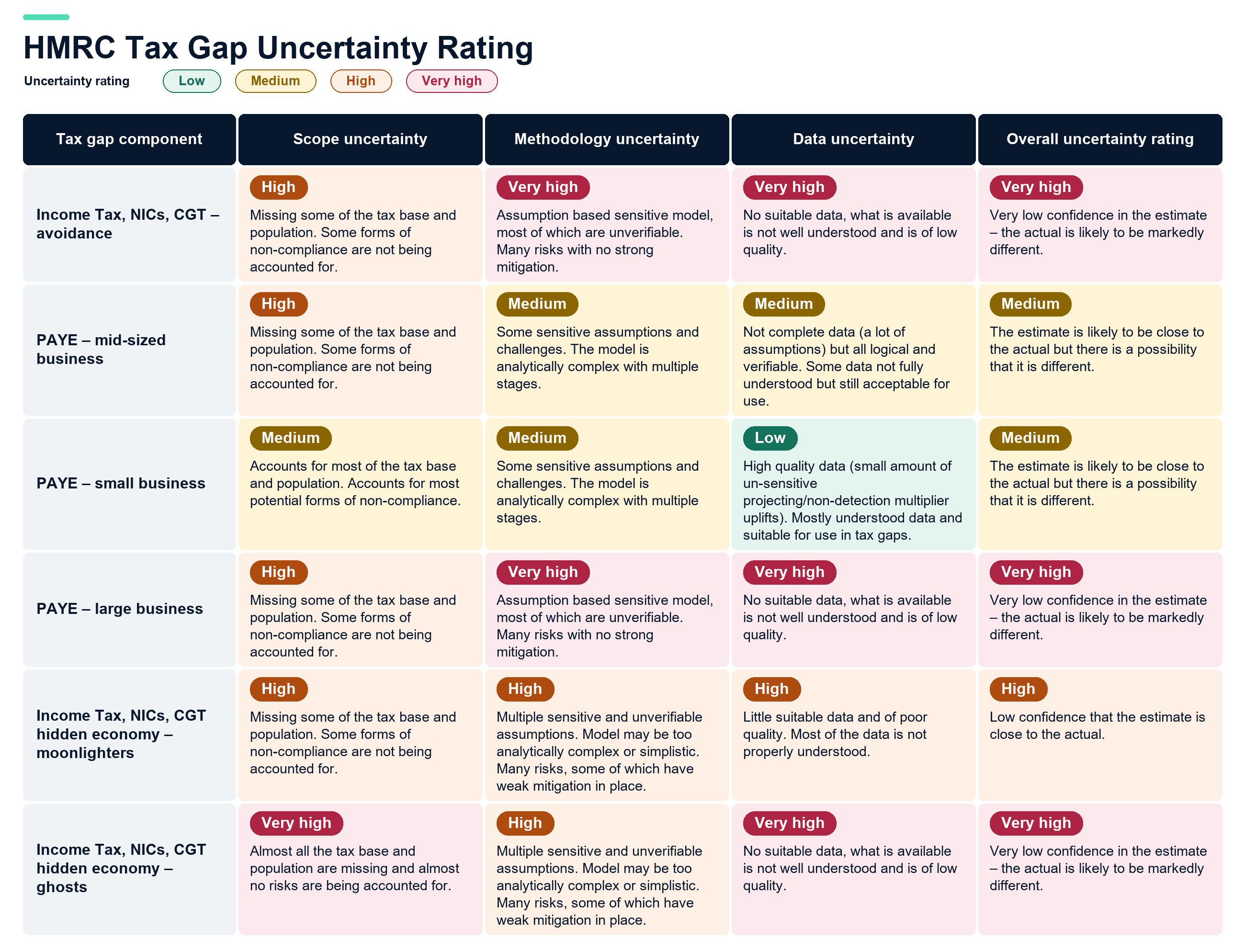
Source: HMRC, Tax Gaps: Methodological annex. The table shows historical ratings; some classifications have since been updated.
Let’s be clear, that doesn't mean the estimate is entirely wrong, or that the entire £59.2 billion tax gap carries the same level of uncertainty. But it does show how difficult some areas of non-compliance are to measure. And it raises a question that goes beyond the statistics themselves.
If an estimate carries a very high level of uncertainty, how much weight should decision makers give it when communicating with the public and making policy decisions?
Why does this matter for government decisions?
The tax gap undeniably helps, alongside other information to decide priority and inform government policy, compliance priorities and decisions about where resources should be directed.
In the Autumn Budget 2024, for example, the government outlined plans to raise an additional £6.5 billion annually by 2029/30 through measures aimed at closing the tax gap.
Improving tax compliance is an important objective, but estimating the amount of tax going uncollected is not the same as identifying how much can realistically be recovered.
The challenge is that estimates of the tax gap can help inform decisions that have very real consequences for businesses. New legislation, additional reporting requirements and changes to compliance guidance can all require organisations to invest time, money and resources into adapting the way they operate.
For recruitment agencies, this is particularly important in an industry that has already experienced significant legislative and regulatory change. If further measures are being informed by estimates that carry high levels of uncertainty, it's reasonable to question whether those measures will achieve their intended purpose or simply add further complexity to businesses already working hard to meet their obligations.
This doesn't mean uncertain estimates should be ignored. They can still provide valuable information about potential non-compliance. But there is an important difference between using an estimate to identify an area that warrants further investigation and using it as part of the evidence supporting changes that affect an entire industry.
The question, then, is whether policymakers have enough reliable information about the underlying problem to be confident that the measures they introduce will actually address it.
Looking beyond the headline figure
As the Budget approaches, we'll undoubtedly hear more about the £59.2 billion tax gap and the government's plans to reduce it. But we'd like to see just as much attention given to the reliability of the figures being used to inform those plans.
HMRC is transparent about the uncertainty surrounding its estimates, and that's important. And considering those estimates are helping to shape decisions about legislation, compliance requirements and enforcement by decision makers, that uncertainty deserves to be disclosed and part of the wider conversation.
We thought it was essential to share this with people who may not know what the tax gap is or why it matters, and to make clear that, when they hear this estimate discussed, some tax gap components carry a very high level of uncertainty.