How SafeRec checks HMRC tax accounts to guard against fraud


SafeRec Team
17 November 2026
Discover how SafeRec uses a controlled browser, two independent video feeds and payroll reconciliation to verify HMRC tax account information and help guard against fraud in the recruitment supply chain.
How do you know that the umbrella companies and recruitment agencies in your supply chain are correctly reporting and paying the PAYE tax they owe to HMRC?
That question has become even more pressing since the introduction of joint and several liability on 6 April 2026. Under these rules, the relevant party could be held liable for all unpaid or incorrectly calculated PAYE arising from an umbrella company arrangement, or where a recruitment agency or another organisation operates PAYE within the supply chain when they use a contract of employment.
But knowing what evidence to ask for is only part of the challenge. Even when an umbrella company or an agency agrees to show you its HMRC tax account, a more fundamental question remains:
How can you be certain that what you are looking at is genuine information from HMRC?
At SafeRec, we have seen first-hand just how difficult that question can be to answer.
During a compliance framework review we conducted for one of our clients, we examined a recording of a company presenting what appeared to be its HMRC tax account during a live video meeting. However, we identified inconsistencies that raised serious concerns about the authenticity of the information being displayed.
Our purpose in sharing this example is to educate. We believe recruitment agencies, MSPs, end clients and the authorities should understand how convincing an HMRC account presentation can appear, and why even a recorded live check may not provide sufficient assurance. Our client has authorised us to share a redacted screenshot from the recording, with identifying details removed.
In this article, we will show you what we discovered and explain why SafeRec's monthly HMRC tax account checks go far beyond screenshots, browser extensions and video recordings, including the controls we use to establish that the information we examine genuinely comes from HMRC. Because the real challenge is not simply being shown evidence of tax compliance. It is knowing whether that evidence can be trusted.
Why screenshots and recordings are not enough
When checking whether a company is paying its taxes, many recruitment agencies ask for a screenshot of its HMRC tax account. Others take things a step further by arranging a live video call, asking the company to log into its account and recording the entire process.
These are sensible precautions, and we understand why businesses take them. After all, watching someone log into the HMRC website and navigate their account in real time should provide some reassurance.
But what if the HMRC tax account you are looking at is not genuine?
The challenge is that a screenshot, a screen share or even a live recording only shows you what is being displayed on someone else's computer. It does not necessarily prove that the information comes directly from HMRC or that it has not been manipulated.
And with today's technology, particularly artificial intelligence, creating convincing digital forgeries is becoming increasingly accessible. What once required technical knowledge can now be achieved with far fewer skills and resources.
This creates an important distinction that we believe every organisation conducting due diligence should understand: Seeing an HMRC tax account is not the same as verifying that you are looking at genuine HMRC information.
The question is not simply whether the check is conducted live, but who controls the computer, software and network used to access HMRC. If the company being checked controls the environment producing the information, the reviewer may have no independent way of knowing whether what they are seeing is genuine.
A compliance framework review we conducted for one of our clients illustrates why this distinction matters.
What a recorded HMRC tax account check revealed
Several months ago, a client approached SafeRec to help review its supply chain compliance procedures. The client had already taken steps to verify HMRC tax accounts of companies in its supply chain. Rather than simply requesting screenshots, it had arranged live video meetings, watched representatives log into their HMRC accounts and recorded the entire process.
However, just weeks after one of these checks, one of the companies concerned had received a winding-up petition from HMRC.
Naturally, this raised questions. How could a company appear to have paid its tax liabilities during a live HMRC account check, only to face winding-up proceedings from HMRC shortly afterwards?
As part of our review, the client shared its recordings of companies' HMRC account checks. One recording in particular raised concerns and illustrates why even a live, recorded check can sometimes provide a false sense of security.
A convincing HMRC login, but something was wrong
In the recording, the company representative appeared to follow the normal process for accessing an HMRC tax account.
The representative navigated to the HMRC website, entered their login details and went through multi-factor authentication. The website address appeared legitimate, and the account displayed the familiar HMRC layout.
The representative then navigated through the PAYE account, scrolling rather quickly through the figures to demonstrate that the company's tax liabilities had been paid.
To someone watching, there was little reason to immediately suspect anything unusual. The meeting was live, the representative's camera was on, and the entire session was being recorded.
But while the representative was scrolling through the account, something appeared on screen that raised an important question about the authenticity of the information being presented.
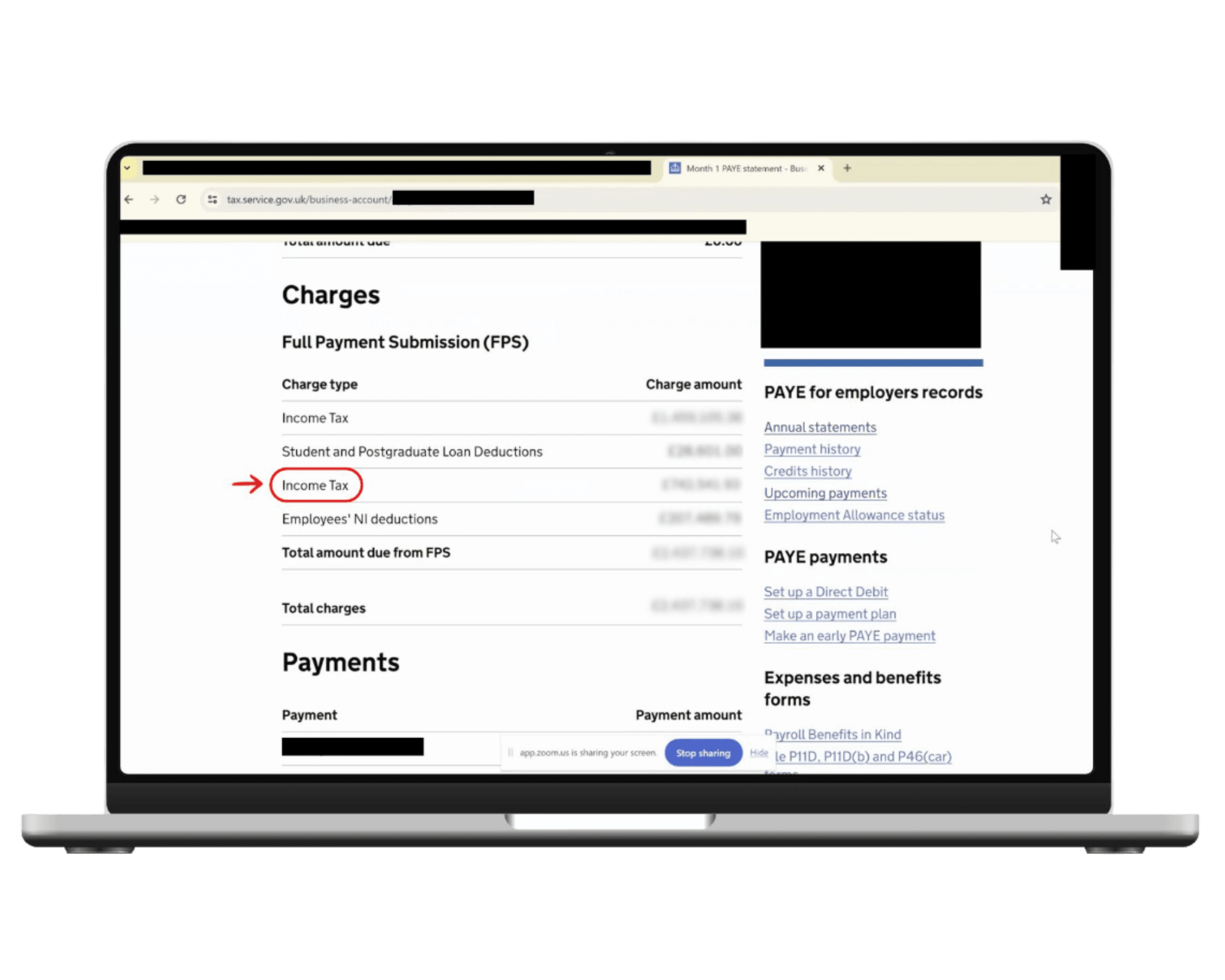
Extract from the company's recorded HMRC account check. Identifying information and financial figures have been obscured.
Look closely at the section showing the charges reported through the Full Payment Submission (FPS).
The recording displays the following entries:
- Income Tax
- Student and Postgraduate Loan Deductions
- Income Tax
- Employees' NI deductions
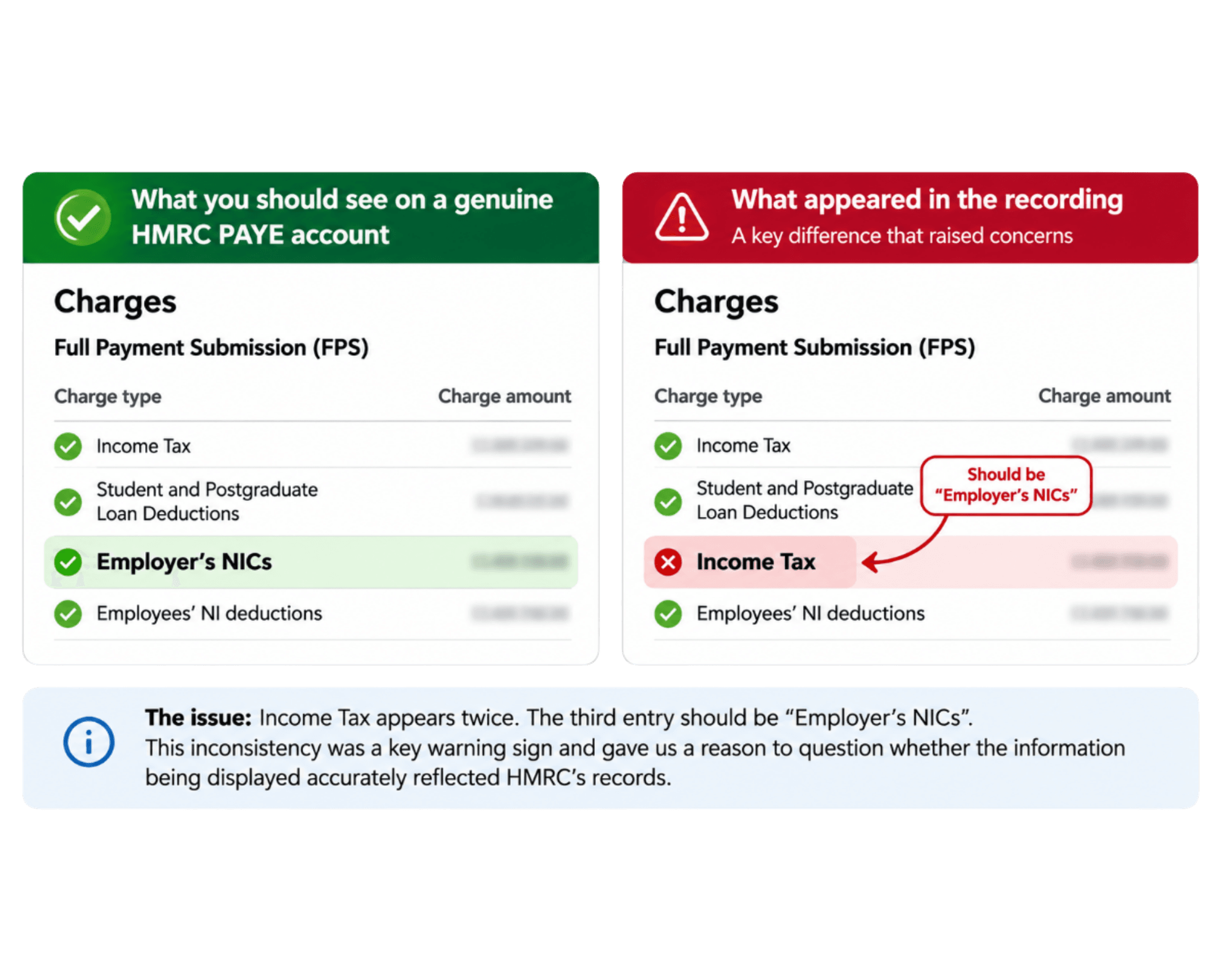
Notice anything unusual? Income Tax appears twice. The third entry should have been "Employer's NICs".
This inconsistency was an important warning sign. It gave us good reason to question whether the information being presented accurately reflected HMRC's records. To resolve these concerns, we offered the company the opportunity to complete an independent HMRC tax account check using SafeRec's secure, controlled browser environment.
The company declined the additional verification and chose to withdraw from our client’s supply chain.
The company subsequently entered administration approximately two weeks after the original recorded check. While this provides important context, neither the decision to decline the check nor the subsequent administration should, on its own, be treated as proof of wrongdoing.
What this example teaches us
We want to be clear about something: the lesson here is not that our client should stop checking HMRC tax accounts. Quite the opposite. The client had taken reasonable steps to obtain evidence and had gone further than simply accepting a screenshot. Its experience demonstrates why the way a check is conducted matters just as much as the information being examined.
With technology advancing so quickly, particularly artificial intelligence, the methods used to verify information need to evolve too. A check that might have appeared sufficient a few years ago may no longer provide the level of assurance businesses need today.
The encouraging part is that there are practical ways to address these risks. We live in an era where artificial intelligence is tackling some of the world's most complex problems and flying cars are becoming a reality. Surely, the way we verify something as important as an HMRC tax account should evolve too.
This is why SafeRec’s certification goes far beyond screenshots, browser extensions or ordinary screen-sharing recordings. We independently verify that the information we examine genuinely comes from HMRC, rather than relying solely on what an umbrella company or agency presents on its screen.
To understand why our approach is different, it helps to consider one fundamental question: who controls the technology used to access HMRC?
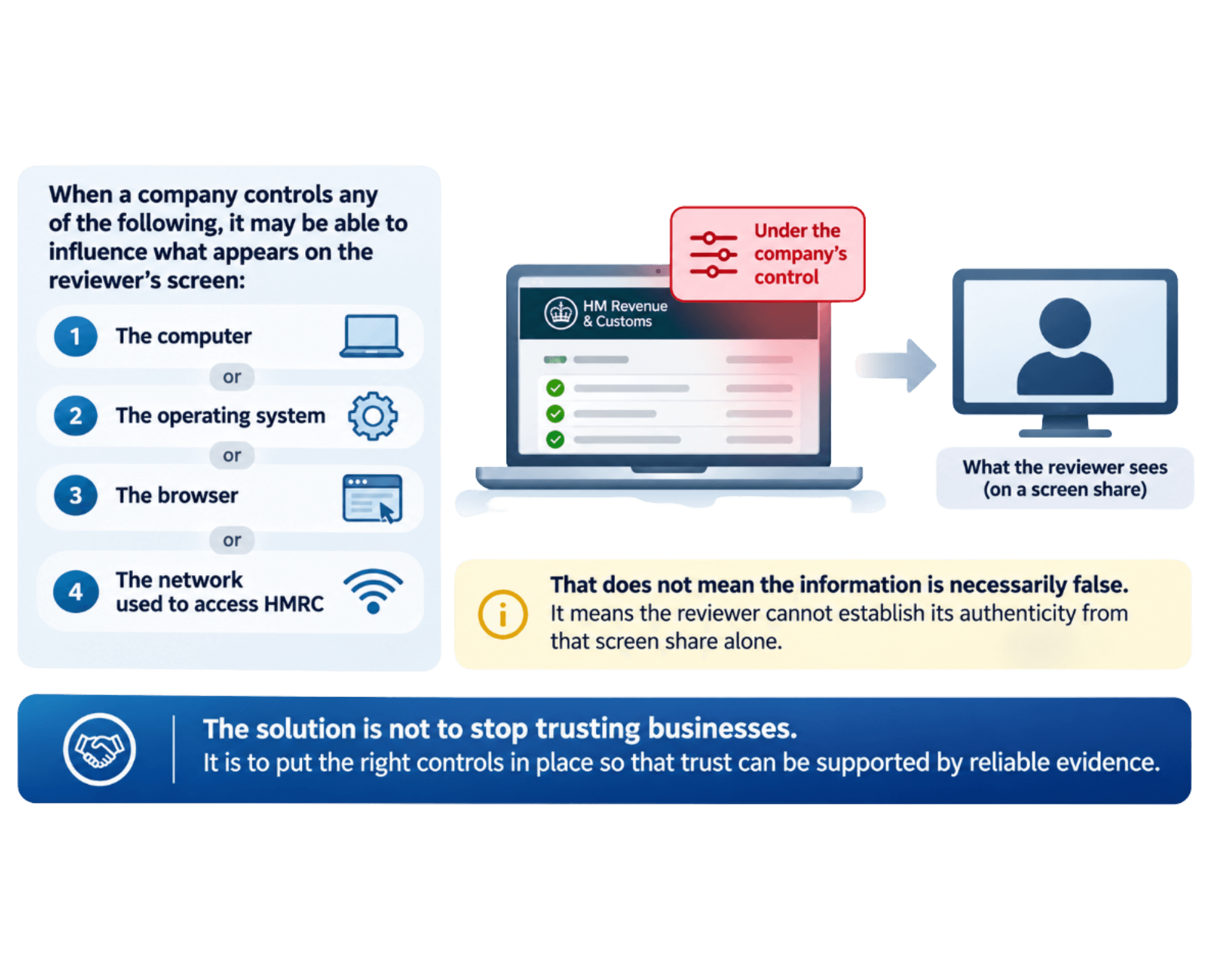
When a company controls:
- The computer; or
- The operating system; or
- The browser; or
- The network used to access HMRC,
it may also be able to control what appears on the reviewer's screen and the reviewer cannot establish its authenticity from that screen share alone.
The solution is not to stop trusting businesses. It is to put the right controls in place so that trust can be supported by reliable evidence.
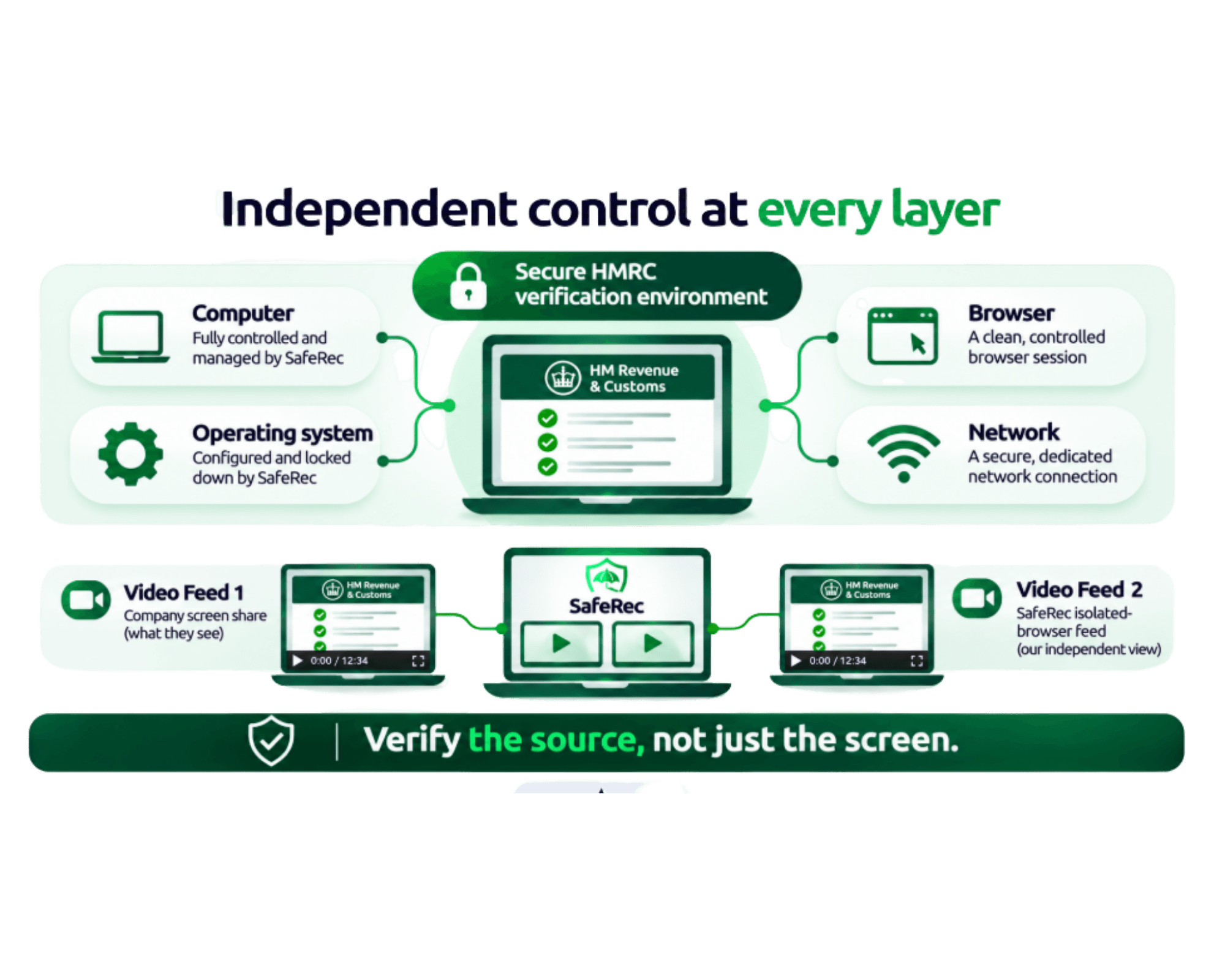
That is the principle behind SafeRec's approach, and why we use an isolated browser and two independent video feeds during our monthly HMRC tax account checks.
How SafeRec checks the account of its Certified Umbrellas each month
At SafeRec, our objective is not simply to watch a company log into HMRC. It is to independently verify that the information we are examining genuinely comes from HMRC and has not been manipulated.
To achieve this, our monthly checks combine a secure, isolated browser environment with two independent video feeds, allowing us to observe the same live session from two different sources.
Step 1 — Accessing SafeRec's controlled environment
During a scheduled video meeting, the company's authorised representative connects to a remotely hosted computer using their own laptop. The representative can operate this computer using their keyboard and mouse, but SafeRec and its hosting provider control the four essential components:
- Computer: The remotely hosted machine.
- Operating system: Its software and configuration.
- Browser: The browser used to access HMRC.
- Network: The connection and settings used to reach HMRC.
The company can operate the computer without controlling the environment in which HMRC is accessed.
Step 2 — Establishing two independent video feeds
Before accessing HMRC, we establish two simultaneous video feeds:
- Video Feed 1 — The company's screen share: The representative shares their screen during the meeting, allowing us to see what they are doing and what they are presenting.
- Video Feed 2 — SafeRec's independent view: Separately, SafeRec receives a direct feed from the hosted computer, showing exactly what is happening inside the isolated environment.
This is a crucial safeguard. If sophisticated software or AI were used to manipulate the company's screen share, that manipulation would not automatically affect SafeRec's independent feed. By comparing both views in real time and recording them, our reviewer can identify discrepancies that would otherwise go unnoticed during a conventional screen-sharing check like the one in this example.
Step 3 — Logging into HMRC and conducting the review
Once our reviewer has confirmed that both feeds are working and showing the same session and that both are being recorded, we instruct the representative to open the isolated browser and log into their HMRC tax account.
The representative enters their own credentials and completes multi-factor authentication. We then guide them through the relevant PAYE and VAT records, including charges, payments, credits and adjustments, asking them to open specific periods or explain entries where necessary.
Throughout the review, SafeRec observes both video feeds simultaneously, comparing the company's screen share with our direct view of the hosted browser.
Both feeds are recorded, preserving independent evidence of what was displayed and the actions taken.
However, verifying that the information genuinely comes from HMRC is only the first step. A genuine HMRC account does not, by itself, establish that every worker has been correctly reported, every relevant PAYE scheme has been disclosed or all tax liabilities have been paid.
This is why SafeRec also examines the relationship between payroll calculations, RTI submissions and the payments, credits and adjustments recorded by HMRC. Authenticity and tax compliance are two separate questions, and both matter.
Why SafeRec developed a different approach
Developing this process took considerable engineering work, technical discussions and testing of different verification methods. We explored screenshots, live video meetings, browser extensions, automated data collection and even checks conducted in person at a company's offices.
Each method had advantages, but each also raised questions about whether the organisation being checked could influence the information presented.
We kept coming back to one conclusion: to independently verify the source of the information, we needed control over the computer, operating system, browser and network used to access HMRC.
Our two-feed approach adds a further safeguard by allowing us to compare the company's screen share with a direct view of the hosted session. It is a more demanding process, but we believe the assurance justifies the effort. Because collecting information is not the same as independently verifying its authenticity.
Browser extensions and automated tools introduce another important consideration: HMRC's rules
Beyond the technical risks, there is also a regulatory issue that recruitment agencies, MSPs and end clients should understand. On 27 May 2026, HMRC published a policy clarification concerning the use of sign-in details, automation and access to its online services.
HMRC confirmed that its existing Government Gateway terms prohibit automation tools that sign in and simulate human activity, including browser automation and screen scraping, whether the software is reading information or submitting it. HMRC-approved APIs are treated separately.
This creates an important consideration for organisations requesting automated HMRC checks.
Imagine a client asking a company in its supply chain to install a browser extension that scrapes and collects information displayed within its HMRC tax account, then transmits that data to a third party.
Even if the extension only collects information, screen scraping may still breach HMRC's Government Gateway terms and conditions. The client could therefore be asking the company to use a tool that breaches HMRC's rules.
And beyond this compliance concern, collecting data from a browser does not establish that the information is genuine. If the information displayed has been manipulated, the extension may simply collect that manipulated data.
We believe due diligence should protect businesses, not introduce additional security risks or require them to breach the rules of the very authority whose records they are trying to verify.
That is why our approach focuses on independent control, genuine HMRC access and verifiable evidence. The objective is not simply to make a check look convincing, but to make manipulation of the information being reviewed substantially harder.
What to ask before relying on an HMRC tax account check
We appreciate the cooperation of the SafeRec Certified umbrella companies that participate in our monthly reviews. Their commitment to independent verification helps strengthen trust and transparency across the recruitment supply chain.
For recruitment agencies, MSPs and end clients reviewing their own supply chains, we believe three questions are particularly important:
- Who controls the environment? Is the HMRC account accessed through a computer, operating system, browser and network independently controlled by the reviewer?
- Can the information be observed independently? Does the reviewer have a direct view of the session, separate from the company's own screen share?
- Does the information reconcile with payroll? Are the relevant HMRC charges, payments and adjustments examined alongside payroll calculations and RTI submissions?
The objective is not to assume that businesses are doing something wrong. It is to ensure that responsible businesses can demonstrate that they are doing things right.
Trust is important. Independent verification makes that trust stronger.
In Part Four of our Investigation Series, we will explore why SafeRec maintained these verification requirements when some businesses asked us to replace them with ordinary screen sharing.