Part Four: When Controls Are Challenged

SafeRec Team
24 November 2026
SafeRec’s investigation continues: when newly acquired umbrella companies challenged certification requirements, we held firm on independent verification, consistent standards and evidence-led compliance.
About our Investigation Series: This article is Part four of our five-part investigation uncovering questionable payroll arrangements, how they are sold and, crucially, how businesses can protect themselves.
Explore the Full Investigation:
- Part One: The Acquisition Wave
- Part Two: Account for Every Worker
- Part Three: Going Undercover
- Part Four: When Controls Are Challenged (This Article)
- Part Five: Transparency, Not Trust (Coming Soon)
A number of recently acquired umbrella companies challenged SafeRec’s certification requirements. What followed became one of the most demanding periods in our history, but our position never changed: every certified business must meet the same standards, without exception.
In Part Three of our Beyond the SafeRec Certification series, we examined how payroll arrangements were marketed and why independent evidence matters. Part Four explores what happened when a small number of newly acquired umbrella companies challenged SafeRec’s compliance framework, and why we remained firm in applying the requirements that every certified business is expected to meet.
Several months ago, on a Monday morning, we contacted our certified umbrella companies regarding their ongoing compliance obligations under the SafeRec Certification framework. For SafeRec, certification has never been about passing an assessment once and displaying a badge. It is an ongoing commitment to independent verification, continuous payroll auditing and compliance with the requirements of our framework. These obligations apply to every certified business, regardless of its size, commercial relationships or ownership.
The vast majority of certified umbrella companies continued working with us as usual, completing the required checks and demonstrating their commitment to transparency and compliance.
However, a small number of recently acquired umbrella companies took a different approach. They challenged aspects of our certification requirements and sought to complete certain verification checks using methods that did not meet SafeRec’s standards.
Our position was straightforward. Every business entering or remaining within the SafeRec Certification framework must satisfy the same requirements. A change of ownership does not create an exception, and neither commercial considerations nor disagreements over our methodology can replace the independent evidence required for certification.
What followed became one of the most challenging periods in SafeRec’s history. Yet throughout it, our teams continued auditing payroll, verifying compliance and supporting the recruitment agencies, MSPs, end clients and workers who rely on our services.
SafeRec’s certification requirements were not open to negotiation. Our responsibility was to apply them consistently, assess the evidence independently and ensure that every business carrying the SafeRec Certified status met the standards behind it.
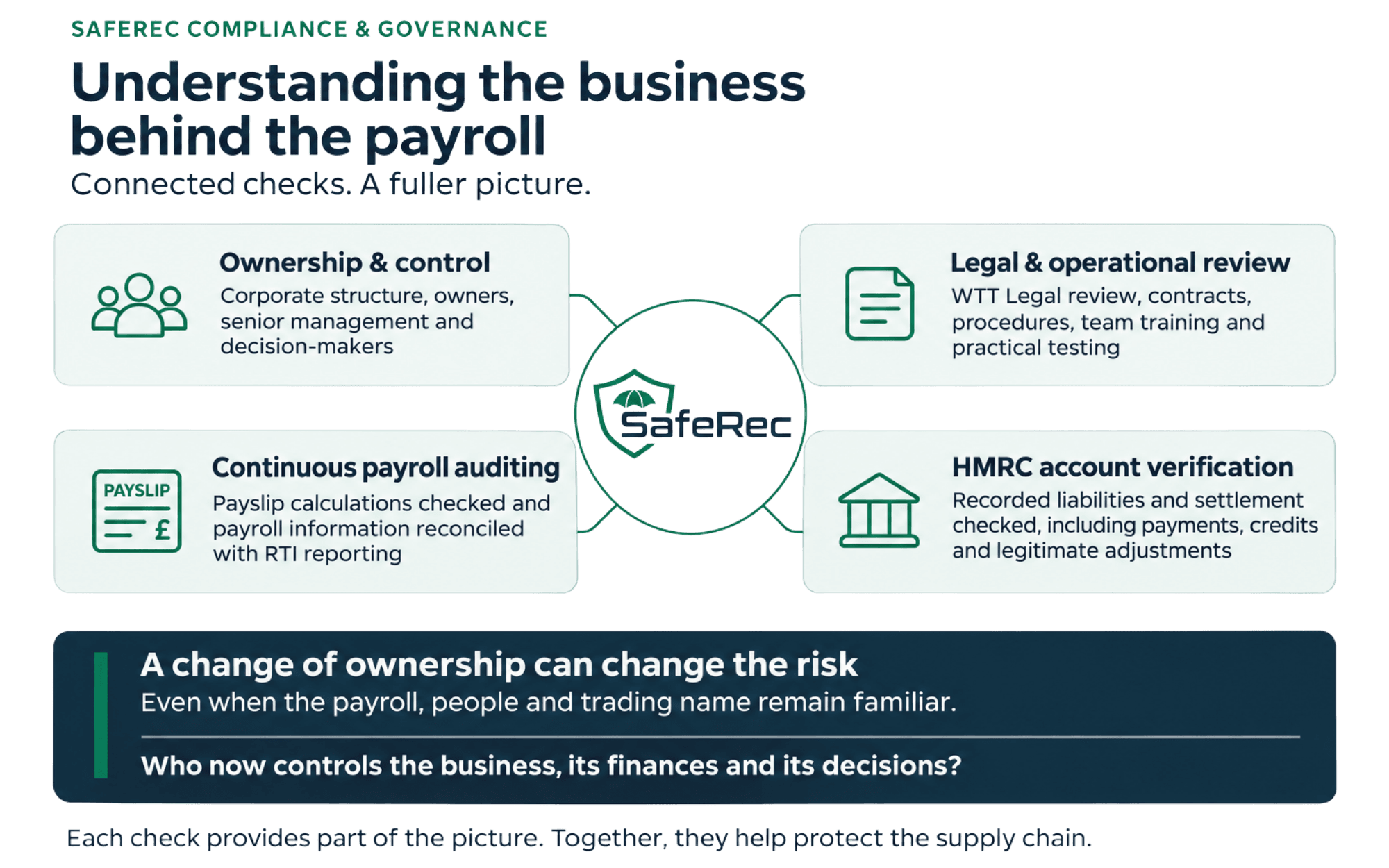
Understanding the business behind the payroll
We founded SafeRec to challenge an approach to payroll compliance that relied too heavily on periodic assessments, documentation and assurances. Our belief has always been simple: compliance should be demonstrated through independent evidence, not simply declared by the business being assessed.
That is why SafeRec Certification goes far beyond checking whether an umbrella company has paid its taxes. Our framework examines who owns and controls the business, how it operates, how workers are employed and paid, and whether its practices meet our compliance standards.
When an umbrella company enters the certification process, we examine its corporate structure, ownership, senior management, contracts and operating procedures. We meet the people responsible for running the business, train their teams on the requirements they must follow and assess how their processes operate in practice.
WTT Legal's independent review forms part of this assessment, examining the umbrella company's legal and operational compliance. Alongside this, SafeRec continuously audits the calculations shown on workers' payslips and reconciles payroll information with RTI submissions to HMRC. Our monthly HMRC tax account verification then examines the corresponding liabilities and whether they have been settled, taking account of payments, credits and legitimate adjustments.
None of these checks is sufficient on its own. A legally compliant contract does not establish that payroll calculations are correct. An accurate payslip does not prove that the corresponding information has been reported to HMRC. And a correctly reported tax liability does not demonstrate that the tax has actually been paid. It is the combination of all of these independent controls that makes SafeRec Certification a comprehensive compliance and governance framework.
This integrated approach also enables eligible recruitment agencies working with SafeRec Certified umbrella companies to access specialist tax liability insurance, providing an additional layer of protection alongside our compliance framework.
But there is another important aspect of certification that is particularly relevant to this investigation: understanding the people behind the business.
When an umbrella company changes hands
As we explored in Part One of this series, 2026 saw an unusual wave of ownership changes across several umbrella companies. Of course, a change of ownership does not automatically mean that anything is wrong. Businesses are bought and sold for perfectly legitimate reasons. However, it is an important event from a compliance perspective because the people ultimately responsible for the company may have changed.
The same payroll professionals may continue doing their jobs. The same relationship managers may answer the telephone. Recruitment agencies may receive familiar invoices under an unchanged trading name.
From the outside, everything may appear exactly as it did before. Yet the people controlling the finances, making strategic decisions and overseeing the company's legal and tax obligations may be entirely different. That is why changes of ownership are subject to scrutiny under SafeRec's certification framework.
Our assessment goes beyond identifying the new directors or shareholders on Companies House. We need to understand who ultimately controls the business, the circumstances surrounding the acquisition and whether the new owners understand the responsibilities they have taken on.
An important part of this assessment is what we internally call the “Y Interview”.
The post-acquisition interview built around “why”
As we explored in Part One, changes in ownership within the umbrella industry raise important questions about the people ultimately responsible for running these businesses.
Under SafeRec’s certification framework, a change of ownership is subject to scrutiny. Alongside our fit-and-proper assessment, we conduct a direct, transaction-specific interview with the new owner.
Internally, we call it the “Y Interview”.
The principle is simple: ask why, and keep asking until we understand the transaction.
Why this business? Why this industry? Why this price? Who introduced the opportunity? Where did the money come from? And why would someone choose to invest in an umbrella company rather than another type of business?
But the questions do not stop at the acquisition itself: Does the new owner understand the company's turnover and profitability? Can they explain how its payroll operates, what its tax obligations are and who is responsible for meeting them? How will they oversee the business and ensure that it continues to meet its compliance obligations?
These are not trick questions. There is nothing inherently concerning about someone entering an industry for the first time, changing careers or investing money they have inherited. But acquiring an established business and understanding the responsibilities that come with running it are two very different things.
The purpose of the Y Interview is not to catch people out or ask them to repeat information already provided on a form. It is to understand the commercial reasoning behind the transaction, establish who is responsible for important decisions and assess whether the new ownership arrangements meet SafeRec's certification requirements.
After all, a company can change ownership without changing its name, employees, offices or relationships with recruitment agencies. From the outside, everything may appear exactly as it did before. Yet the people responsible for its finances, strategy and compliance may have changed completely.
And this is not limited to umbrella companies. Recruitment agencies can also change ownership while continuing to operate under the same name, with the same staff and established client relationships.
For MSPs and end clients, a familiar supplier does not necessarily mean that the people responsible for that supplier have remained the same. That is why a change of ownership requires more than a Companies House check. It requires an understanding of the business, the transaction and the people now responsible for running it.
For SafeRec, the principle is clear: a change of ownership does not change the standards a certified business must meet. New owners must demonstrate that they understand their responsibilities and that the business continues to satisfy every requirement of our certification framework.
Back to the story: the newly acquired umbrella companies
But let’s return to where this story began: that Monday morning communication to our certified umbrella companies. What followed was anything but routine.
While the vast majority of SafeRec Certified umbrella companies continued working with us as usual, a small number of recently acquired businesses challenged our requirements and sought exceptions to the conditions for maintaining their certification.
For SafeRec, the principle was straightforward. Every certified business must meet the same standards, regardless of its ownership, size or commercial relationships. Companies are entitled to question our methodology, challenge our conclusions and seek clarification. In fact, constructive scrutiny is something we welcome. But certification cannot depend on allowing individual businesses to choose which verification requirements they are prepared to meet.
We engaged with the businesses concerned, explained our position and remained available to help them complete the necessary checks. However, we also made clear that certification could only continue where the required evidence had been provided and the applicable standards satisfied. Making exceptions would have undermined the consistency of our framework and, ultimately, the confidence placed in it by the recruitment agencies, MSPs, end clients and workers who rely on SafeRec.
Our responsibility was not to make certification easier to retain. It was to protect the integrity of the standards behind it and the trust that the recruitment industry places in SafeRec.
Ten working days unlike anything we had experienced
While SafeRec was dealing with these certification matters, we also experienced a series of extraordinary events. Within just ten working days, anonymous allegations about SafeRec circulated within the industry, members of our team received threatening telephone calls, and several businesses formally challenged our certification requirements through legal advisers. Since SafeRec's inception, we had never encountered anything comparable, and we have not experienced anything similar since. We have chosen to share these events because they form part of our company's history, but it is important to distinguish the chronology from any conclusions about responsibility. We do not know who was behind the anonymous communications, have not established that these incidents were connected and do not attribute them to the businesses involved in the certification disputes.
It began on Wednesday, when an anonymous email was circulated to SafeRec Certified umbrella companies and a couple of recruitment agencies. The message contained allegations about SafeRec, its platform and its certification processes. After reviewing the claims, we were surprised to find them inaccurate, poorly researched or based on misunderstandings of how our framework operates.
SafeRec's owners also experienced a series of anonymous telephone calls, some arriving late at night, that went far beyond anything we had previously encountered in running the business. The calls included explicit threats and demands that SafeRec change its operating practices, making them far more serious than an expression of disagreement or criticism. There was also an attempt to obtain personal information about a senior member of our team. For a business whose purpose is to improve compliance and transparency within the recruitment industry, experiencing this level of intimidation was unprecedented. We considered the incidents sufficiently serious to report them to the police and request an investigation. Importantly, we do not know who was responsible for these calls or what motivated them, and we have no evidence connecting them to the anonymous email, the umbrella companies challenging our certification requirements or their legal advisers. We are reporting what happened, without attributing responsibility to anyone.
On Friday, SafeRec received several formal legal letters from advisers representing recently acquired umbrella companies, challenging aspects of our certification requirements. As with any certification dispute, our decisions remained focused on the applicable requirements and the evidence provided.
We responded to the correspondence, explained our position and maintained the deadlines. Some businesses chose to resign from the certification programme, occasionally just minutes before their deadlines expired, while others lost their certification when the required checks remained incomplete. None of the businesses that declined to meet SafeRec's requirements remains certified today. These were not decisions we took lightly, but certification must mean the same thing for everyone. Making an exception for one business would compromise the integrity of our certification framework and the trust that recruitment agencies, MSPs, end clients and workers place in the standards we uphold. That was not a compromise we were prepared to make.
Throughout this extraordinary period, our teams continued doing what they do every day: auditing payroll, examining compliance and supporting the recruitment supply chain. We addressed the legal challenges, reported the threatening incidents to the police and remained focused on our responsibilities. Ultimately, SafeRec's independence is not something we can simply promise to the industry. It is something we must demonstrate through our actions, especially when doing so becomes difficult. And throughout those extraordinary days, that is exactly what our team did.
Doing the right thing, whatever the pressure
Looking back, these events reinforced something fundamental about SafeRec: our independence is not negotiable. In just twelve months, we have grown into a team of 24 people, with dedicated teams, clear responsibilities and independent controls designed to ensure that certification decisions are driven by evidence, not commercial interests or external pressure.
Despite that growth, we have never lost the mindset that brought us here. We still think like the underdog, challenging established practices, improving our technology and questioning whether the industry can do better. We have no interest in confrontation. Our ambition is to work alongside umbrella companies, recruitment agencies and everyone genuinely committed to raising standards. But independence is not demonstrated when everyone agrees with you. It is demonstrated when maintaining your standards becomes uncomfortable.
SafeRec was founded to challenge the status quo, not to become part of it. We will continue asking difficult questions, insisting on independent evidence and making decisions based on what our audits establish. Because protecting the recruitment supply chain sometimes means making difficult decisions, even when doing so comes at a cost. And that is a responsibility we will never compromise.
Next: Part Five — Turning the investigation into practical supply-chain protection.